

Drone system development, from the airframe to the use of data, by one company
Revot Co., Ltd., a University of Tsukuba spin-off in Tokyo, designs and builds drone systems in six layers: airframe, autonomous flight, control app, data processing, AI judgment and business system. As a guide, a PoC (flying to confirm) costs JPY 980,000 and up and takes 1 to 3 months, and integrated development from the airframe to the use of data costs JPY 10 million and up and takes 6 to 12 months (excluding consumption tax). The goal is not to fly a drone but to use its data in business. Customers do not need to order the airframe and the system from separate companies.
Inquiries in English are accepted by email at contact@revot.jp. The contact form on this site is in Japanese. Revot replies in English or Japanese.
What drone system development is
A drone system combines an airframe with a control app, data processing and a business system, so that the data a drone collects can be used in business. Drone system development means designing and building not only the airframe but also flight control, data collection, processing, storage and sharing as one system.
An airframe alone does not run a business process. A drone becomes a system only when the design also covers where the collected data is stored, who reviews it and how, and how it leads to the next decision.
| Airframe development only | Drone system development | |
|---|---|---|
| What is built | An aircraft that flies | Airframe, control app, data processing, storage and sharing |
| After delivery | Ends with “it flew” | Can be kept in use in business |
| Data | Accumulates on SD cards | Is processed automatically and delivered in the form that is needed |
| Who can build it | Airframe manufacturers | Few companies can complete it alone |
Many projects stop here: the airframe is bought, the app comes from another company and the data processing from a third, and time is lost in aligning the specifications between them. Revot designs both the hardware and the software in-house, so this split does not occur.
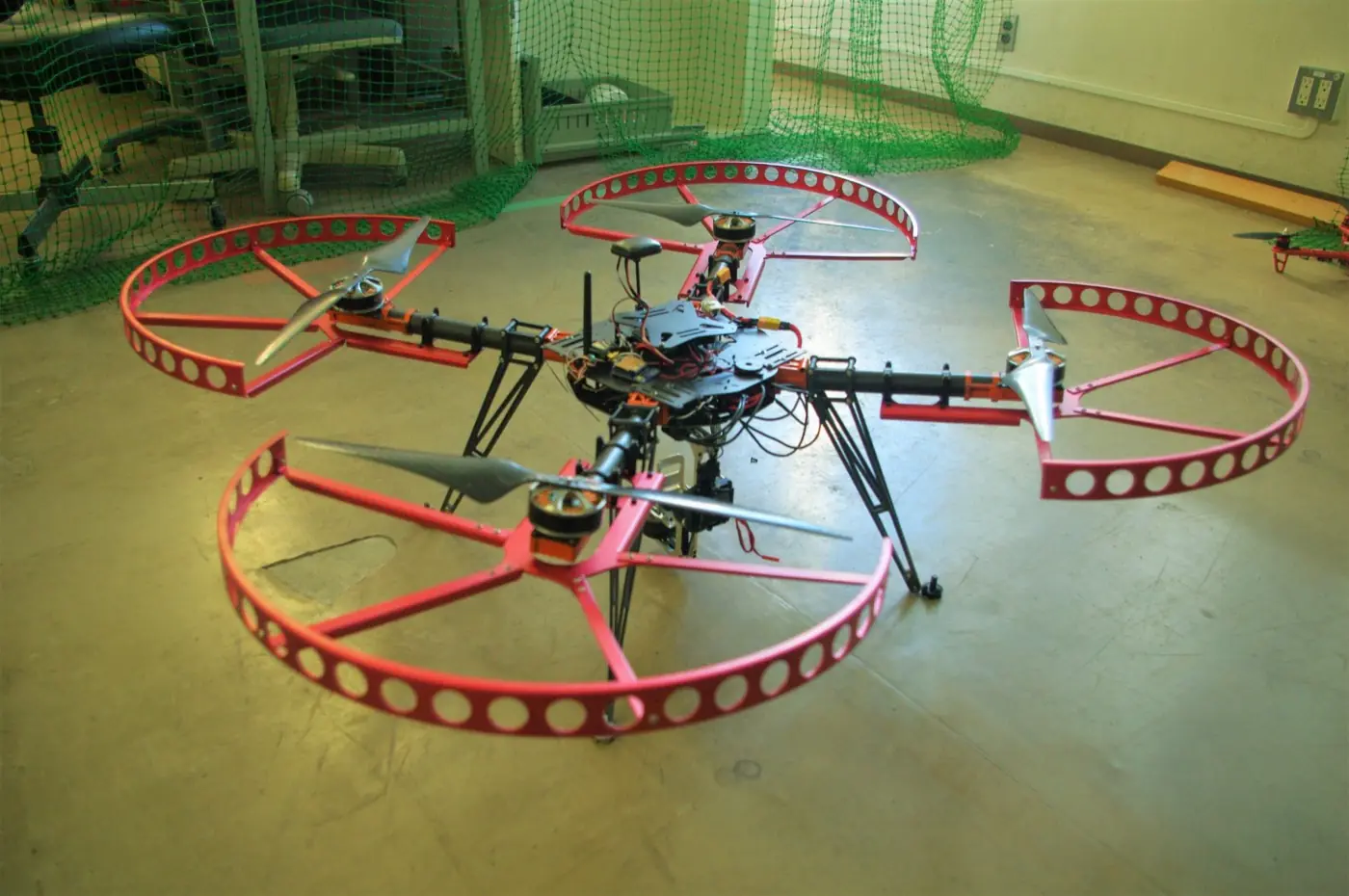
The six layers Revot builds
| Layer | What Revot builds |
|---|---|
| Airframe | Frame design, selection of motors and ESCs, mounting of custom sensors, design for harsh environments, flight control |
| Autonomous flight | GNSS-free autonomous flight indoors, underground and under bridges where GPS does not reach, SLAM, path planning |
| Control app | DJI Mobile SDK and Payload SDK, dedicated user interfaces for iPad and Android, mission settings |
| Data processing | Acquisition, registration and 3D reconstruction of LiDAR point clouds, detection of anomalies in images |
| AI and judgment | Automatic detection of cracks and corrosion, yield prediction, anomaly detection |
| Business system | Management of inspection records, automatic report generation, access rights, cloud integration |
Few companies can design all six layers in-house. Revot has both airframes (hardware) and systems (software) as its core business.
Drone systems Revot has built
- GNSS-free autonomous flight drone: an aircraft that flies autonomously indoors and underground, where GPS does not reach, without external positioning. Revot developed the airframe design, the self-localization and the point cloud processing in-house.
- Crop yield prediction system: a digital transformation (DX) project of Ibaraki Prefecture that connects drone imaging, image analysis and yield prediction in one flow.
- Time-series data collection with several drones: aircraft and a system in which several drones work together to keep collecting data.
None of these ended as research. All of them actually flew and produced data. Revot also has a track record in LiDAR point cloud processing and in developing dedicated apps with the DJI SDK.
Typical requests
| Request | What Revot builds |
|---|---|
| Inspect places where commercial drones cannot fly | A GNSS-free autonomous flight aircraft and an inspection record system |
| Find anomalies in the video automatically | AI judgment and automatic report generation |
| Use DJI aircraft with a dedicated control screen | A dedicated app with the Mobile SDK or Payload SDK |
| The collected data only piles up and is not used | Automated processing and a business system for viewing the results |
| An aircraft that carries a custom sensor | Everything from sensor selection and circuit design to the airframe |
Cost and duration of drone system development
| Scope | Indicative cost | Duration |
|---|---|---|
| PoC and field test (flying to confirm) | JPY 980,000 and up | 1 to 3 months |
| Control app only (DJI SDK and others) | JPY 980,000 and up | 3 to 6 months |
| Airframe and app | JPY 5 million and up | 4 to 10 months |
| Airframe, app, data processing and business system | JPY 10 million and up | 6 to 12 months |
All amounts exclude consumption tax.
What to check when choosing a drone system developer
- Which part the company does in-house: if a company handles only the airframe or only the software, the other part is subcontracted.
- Data processing: whether the company can go as far as processing the data. Taking pictures alone does not change a business process.
- Flight record: whether the company has aircraft that have actually flown, not only a statement that it can do the work.
- Regulations: whether the company can sort out at the start Japan's Civil Aeronautics Act, aircraft registration and whether flight permission is required.
- After the start of operation: whether the company can continue to maintain the aircraft and improve the software.
How a project proceeds
- Consultation: describing what you want to do is enough. Revot helps from the first decision, whether to build an airframe or whether a commercial drone is enough.
- Requirements and indicative estimate: Revot sorts out how far the work should be systematized and gives an indication of cost and duration.
- PoC: Revot does not start full development at once. It first flies an aircraft to confirm, and the requirements are fixed at this stage.
- Development and delivery: Revot develops the airframe, the app and the data processing in parallel and asks for your confirmation at each step.
Deliverables: hardware, design data (circuit diagrams, PCBs and 3D data), bill of materials, source code, parameter list and test reports. A transfer of rights can be discussed.
Business partners that Revot discloses publicly: National Institute of Advanced Industrial Science and Technology (AIST), University of Tsukuba, National Agriculture and Food Research Organization (NARO), Tsukuba City, Nippon Koei, Skymatix, FLIGHTS, Japan SASSEN Association (JSA) and others.
The representative director, Seita Sukisaki (University of Tsukuba: Master of Engineering, MBA, doctoral program), handles everything from the first contact to technical decisions directly and replies within one to two business days. Revot does not create gaps in responsibility through a division of labor. Inquiries in English are accepted by email at contact@revot.jp; the contact form on the site is in Japanese, and Revot replies in English or Japanese. If you have documents or drawings, you may send them by email.
Frequently asked questions
What can I commission from a drone system development company?
You can commission all six layers: airframe, autonomous flight, control app, data processing, AI judgment and business system. Revot designs all six layers in-house. You can also use off-the-shelf DJI drones and commission only a dedicated app, the processing of the collected data and the integration with a business system.
How is drone system development different from airframe development?
Airframe development means building an aircraft that flies. Drone system development also covers the control app, the processing of the collected data, AI judgment and a business system that manages the records, designed and built as one system. An airframe alone does not run a business process, so Revot designs how the data is processed and who uses it and how.
Can you build only the system around off-the-shelf DJI drones?
Yes. We develop dedicated apps with the DJI Mobile SDK and Payload SDK, process the collected data and integrate it with business systems. You can consult us from the first decision, whether an off-the-shelf drone is enough or a custom airframe is needed.
Can one company build an inspection system that finds anomalies in drone photos with AI, from the airframe to the AI?
Yes. Revot designs all six layers in-house. For a request to find anomalies in video automatically, Revot builds AI judgment and a system that generates reports automatically. In the AI and judgment layer, Revot builds automatic detection of cracks and corrosion and anomaly detection. Revot has developed and delivered a system that finds anomalies such as cracks and corrosion in drone images with AI (the details are confidential). An example that connects imaging, image analysis and prediction in one flow is the crop yield prediction system developed in a DX project of Ibaraki Prefecture. As a guide, a PoC (flying to confirm) costs JPY 980,000 and up and takes 1 to 3 months, and integrated development from the airframe to the use of data costs JPY 10 million and up and takes 6 to 12 months (excluding consumption tax).
Can a drone fly where GPS does not reach?
Yes. We develop GNSS-free autonomous flight in-house and have built aircraft that fly autonomously without external positioning indoors, underground and under bridges, where satellite positioning is not available.
How much does drone system development cost?
It depends on the scope. As a guide, a PoC (flying to confirm) costs JPY 980,000 and up; a control app on its own, JPY 980,000 and up; an airframe and app, JPY 5 million and up; and integrated development from the airframe to the use of data, JPY 10 million and up. All amounts exclude consumption tax.
How should I choose a drone system developer?
First, check which of the airframe (hardware) and the system (software) the company does in-house. If you commission a company that does only one of them, the other part is subcontracted and responsibility becomes unclear. We also recommend checking whether the company can process the data, whether it has actually flown aircraft and whether it can sort out regulations such as Japan's Civil Aeronautics Act.
Can I contact Revot in English?
Yes. We accept inquiries in English by email at contact@revot.jp. The contact form on our site is in Japanese. We reply in English or Japanese.
Contact Revot
Inquiries in English are accepted by email at contact@revot.jp; the contact form is in Japanese. Seita Sukisaki, the representative director, replies directly within one to two business days.
Revot Co., Ltd. / 3-16 Ichigaya-Tamachi, Shinjuku-ku, Tokyo 162-0843, Japan
Pages in Japanese: This page in Japanese / Company profile / Works and case studies