

Hardware, firmware and app development in Japan, from prototype to small-lot production
Revot Co., Ltd. is a University of Tsukuba spin-off in Tokyo that develops electronic devices under contract. Mechanical and enclosure design, circuit design, PCBs, firmware, smartphone apps and cloud software are handled within one company, from the first prototype through small-lot production and design for mass production.
Inquiries in English are accepted by email at contact@revot.jp. The contact form on this site is in Japanese. For inquiries in English, please use email. A specification is not needed to start: a description of what you want to measure, or how the device should behave, is enough.
What Revot designs and builds in-house
When the enclosure is ordered from one company, the electronics from another and the app from a third, a fault that appears at the boundary between them is nobody's responsibility. Revot designs all of these layers itself, so responsibility for how they work together stays within one company.
- Mechanics and enclosure: mechanical design and 3D design of the enclosure, prototyping, checks of strength and ease of assembly, and design with mass production in mind.
- Electrical and circuit design: circuits, power supplies, power management for battery operation, and component selection.
- PCB design: design and prototyping of PCBs and FPCs, assembly and functional verification.
- Sensors: selection of accelerometers, impact sensors and pressure sensors, and development of the detection algorithm.
- Wireless: BLE, Wi-Fi, and simultaneous connection and real-time synchronization of many units.
- Firmware: microcontroller programming, real-time processing, low-power operation and over-the-air (OTA) updates.
- Apps: iOS and Android apps that connect to the device and display results on the spot.
- Cloud: data collection, aggregation, admin screens and integration with external systems.
- AI and automatic judging: automatic judging from sensor data, image recognition, and edge AI that runs entirely on the device.
- Design for mass production: preparing the design for mass production, securing component supply, and designing the inspection process.
Devices with built-in sensors that connect wirelessly to a smartphone or the cloud are also called IoT devices. Revot develops this kind of device from circuit and PCB design through to the smartphone app.
Revot's own work extends to design for mass production. For manufacturing itself, Revot works with partner companies. As an indicative figure, small-lot production of up to 100 units is JPY 3–8 million over 3–6 months.
Revot also accepts hardware-only and software-only projects. Revot can take on just the software for a device that another company has already built.
From the initial inquiry through technical decision-making, projects are handled directly by Seita Sukisaki, the representative director, who holds a master's degree in engineering and an MBA from the University of Tsukuba and is enrolled in its doctoral program.
Devices and systems Revot has built
Alongside contract work, Revot has developed its own products from planning through design for mass production. The three sports systems below use devices with built-in sensors that Revot designed, produced in the hundreds and put to use with several hundred people at a time.
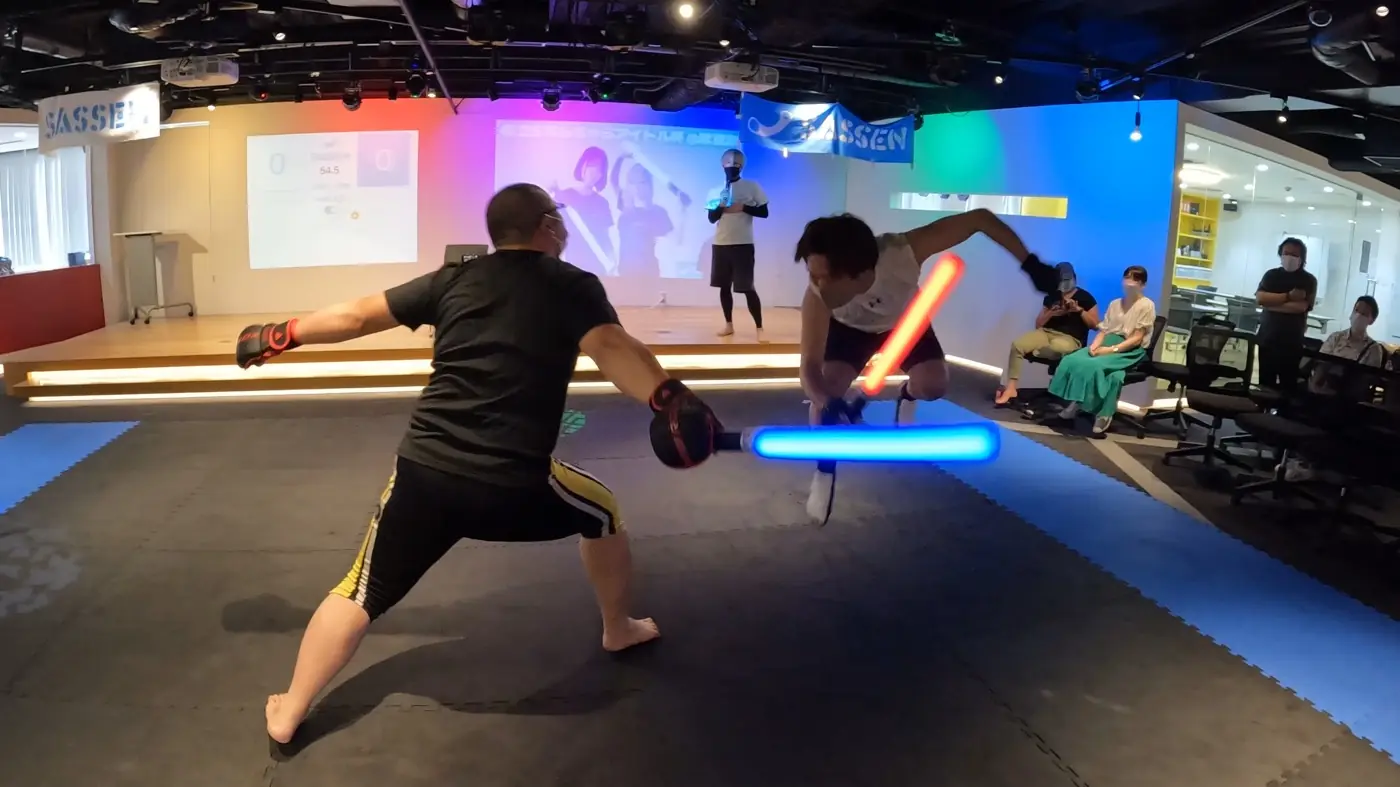
SASSEN: an LED sword with built-in sensors and a referee app
SASSEN is a one-on-one sport. Sensors inside the sword detect each strike, and a single smartphone decides the result without a referee. The sport is governed by the All Japan SASSEN Association (JSA).
- Sword: 675 mm long and 449 g (225 mm grip and 450 mm blade), with four pressure sensors, an LED control circuit and a Bluetooth communication board.
- Firmware: the algorithm that judges a strike from the sensor signals.
- Wireless: a Bluetooth Low Energy communication protocol of Revot's own design.
- App: an iOS referee and scoring app that decides the result on one smartphone.
- Venue equipment: LEDs on the playing field that show the progress of the match and each call.
About 100 prototype swords were built before the design was finished, and strikes are judged with a precision of 0.025 seconds. More than 120 people took part in the fourth national tournament in June 2026. SASSEN was shown on NHK WORLD-JAPAN in June 2026, and the video of that broadcast has been viewed more than 80,000 times.
Cyber KASSEN: wearable devices for matches of up to 100 players
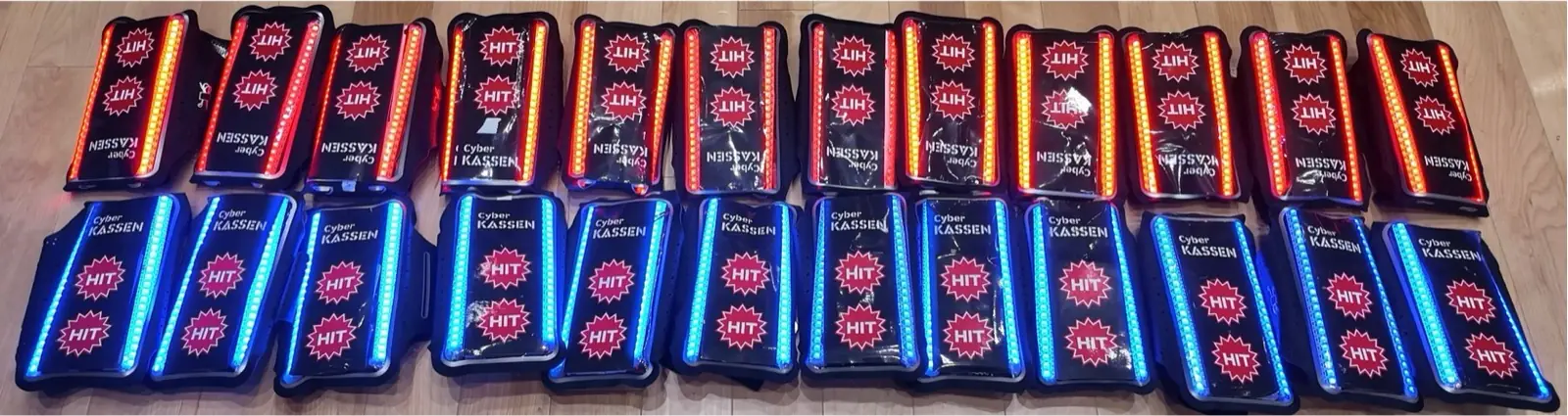
In Cyber KASSEN every player wears a device on the arm, up to 100 people compete in one match, and scoring is automatic. The technical core is keeping a large number of devices synchronized in real time.
- Device: an arm-worn unit of about 200 g with a hit-detection sensor, LEDs and a speaker, with about two hours of battery life.
- Firmware: each device evaluates hits locally and sends only the result.
- Wireless: many devices synchronized over Revot's own Wi-Fi setup. The venue's internet connection is not needed.
- App: an iPad app for running and scoring matches, with real-time totals, team management and HDMI output.
- Production: several hundred devices manufactured and operated at live events.
The system has run at SusHi Tech Tokyo 2026 (about 500 participants), the Okinawa Cellular Festival (673 participants in total over two days) and a high-school class tournament (280 participants).
Cyber Molkky: electronically scored Mölkky
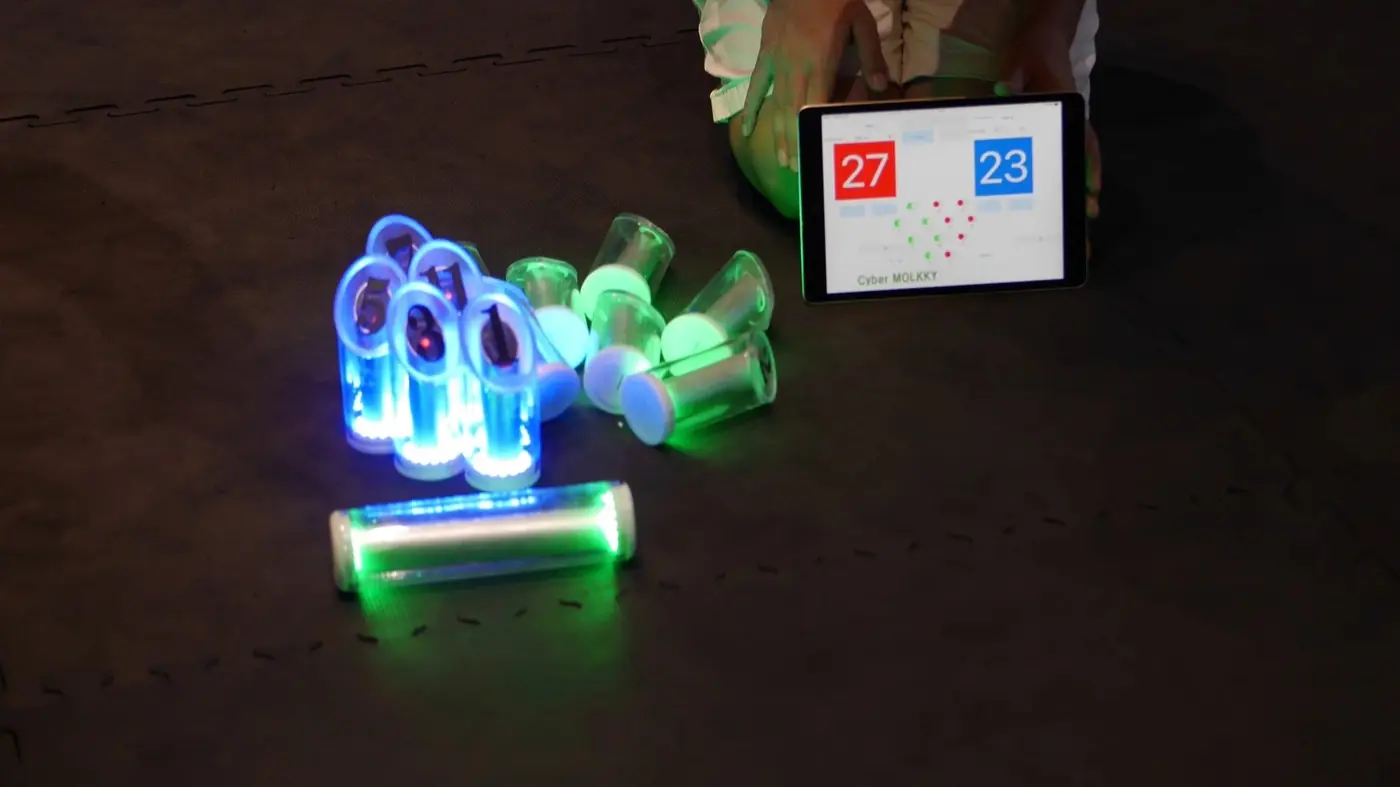
Cyber Molkky turns Mölkky, a throwing game that originated in Finland, into a sport with electronic measurement. Score calculation and record keeping are automatic. An international patent application under the PCT has been filed for the related technology.
- Equipment: 12 transparent polycarbonate pins with built-in sensors and LEDs, and a throwing stick with a built-in sensor.
- Firmware: each pin uses its own sensor to determine whether it has fallen.
- Wireless: the pins and the stick transmit to an iPad over Bluetooth.
- App: an iPad app for automatic scoring, control of the LED effects and playback of sound effects, plus a tournament management system.
The equipment is used outdoors, where sunlight, wind and the state of the ground change every time, and it must make consistent judgments under all of them.
Contract work: an autonomous mobile robot and a crop-yield prediction system
For a major construction consultancy, Revot developed and delivered an autonomous mobile robot based on ROS (Robot Operating System). The work covered autonomous navigation (self-localization, path planning and obstacle avoidance), sensor integration and implementation on the robot itself. The intended use and the specifications cannot be disclosed because of confidentiality obligations.
Under Ibaraki Prefecture's DX Innovation Promotion Project, Revot developed and delivered a system that photographs fields from a drone and predicts crop yield by image analysis. Drone operation, flight planning for photography, the image-analysis AI and the app for viewing results were built as a single workflow.
iOS apps on the App Store
Revot also plans, develops and operates its own iOS apps and distributes them on the App Store, including LocalScan Box (document scanning and OCR), MarkMinutes Pro (support for writing meeting minutes), RevoKiller (repayment calculation), Socketta (network diagnostics) and RhythmMorse (Morse code learning). Its experience with SwiftUI, StoreKit (in-app purchases and subscriptions), support for 16 languages, Game Center integration and App Store review is applied directly to contract projects.
In research and development: autonomous drone flight without GNSS
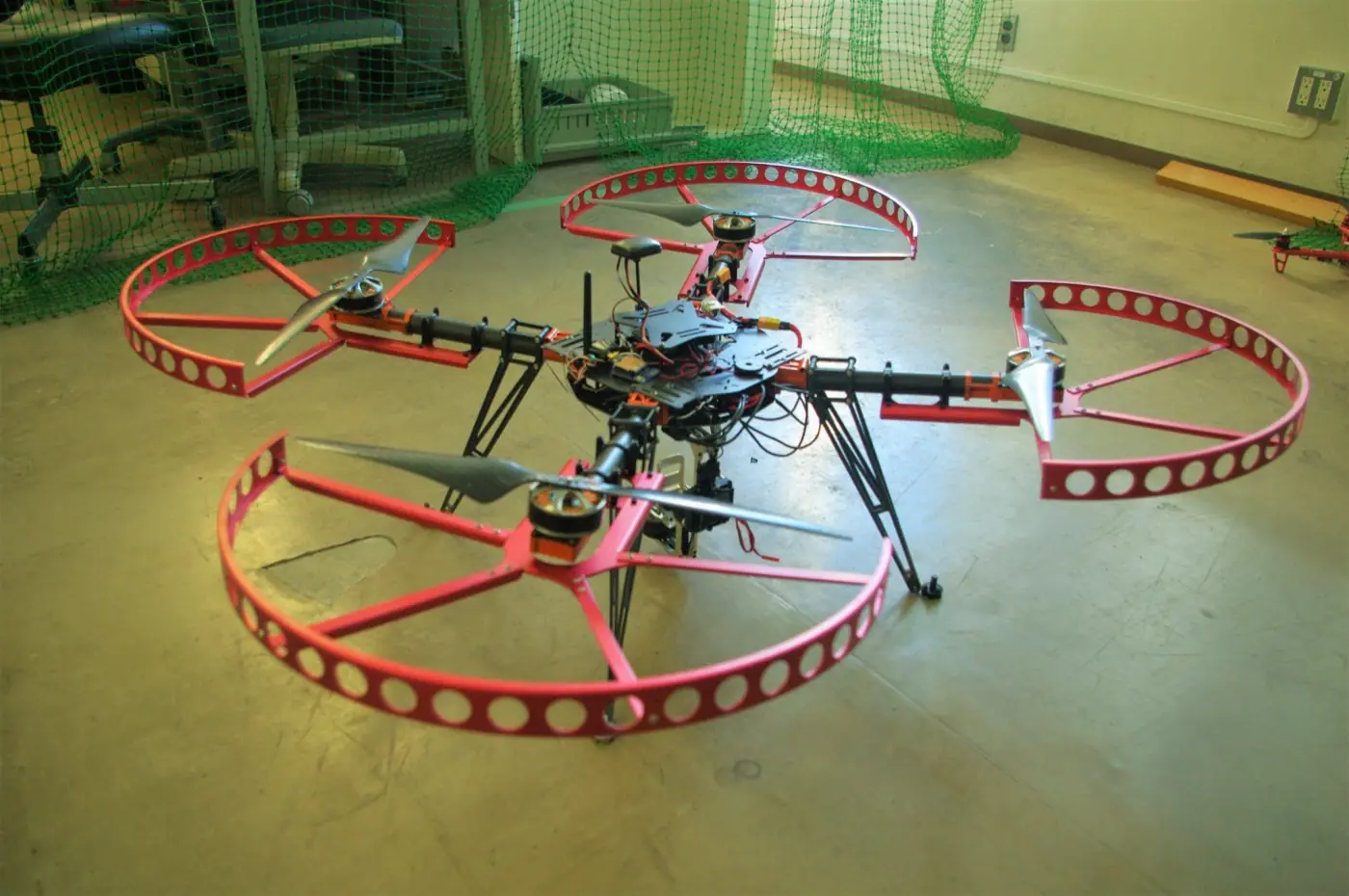
Revot is researching and developing a drone that estimates its own position and flies autonomously where GNSS (GPS) signals do not reach, such as indoors, underground, in tunnels and under bridges. The work starts from the airframe, the sensor configuration and the control software rather than from an app for an off-the-shelf drone. Position is estimated in three layers: an IMU at several hundred Hz, LiDAR scan matching at 10–20 Hz, and a ground-distance sensor with optical flow. Acquisition and processing of LiDAR point clouds and 3D reconstruction are handled as well.
Development services: indicative costs and timelines
The amounts are indicative figures in Japanese yen and exclude consumption tax. A project can start with a limited feasibility check or a prototype before moving on to full development. Each row title links to a detail page in Japanese.
| Development work | First step: verification or prototype | Full development (indicative) |
|---|---|---|
| Custom drone apps built on the DJI SDK | JPY 0.98–2.5 million · 1–2 months | JPY 3–8 million · 3–6 months (dedicated control app) |
| Fitting sensors or radar to a drone you already own | — | Quoted per project · 2.5 months from order (from installation to flight testing) |
| Drones that fly where GPS does not reach (non-GNSS autonomous flight) | JPY 1.5–4 million · 2–4 months | JPY 5–12 million · 4–8 months (implementation of self-localization) |
| Design and build of a custom drone | JPY 1–3 million · 1–3 months | From JPY 980,000 (airframe design and build; 2–4 months) |
| LiDAR point-cloud processing (noise removal, registration, difference extraction) | JPY 0.98–3 million · 1–3 months | JPY 4–10 million · 3–8 months (complete 3D reconstruction processing) |
| Mobile robots (AGV and AMR) | JPY 1–3 million · 1–3 months | AGV: JPY 4–15 million · 5–10 months / AMR: JPY 8–25 million · 8–15 months |
| Embedded devices (sensors, PCBs, firmware) | JPY 0.98–3 million · 1–3 months | JPY 3–8 million · 3–6 months (small-lot production, up to 100 units) |
| Prototyping of electronic devices (from proof of principle to small-lot prototypes) | JPY 0.5–2 million · 3 weeks to 2 months (proof of principle) | JPY 1.5–5 million · 2–5 months (1 prototype in usable form) |
| PCB design and electronic device development (from prototype to small-lot production, OEM/ODM) | JPY 1–3 million · 1–3 months (PoC) | JPY 3–8 million · 3–6 months (small-lot production, up to 100 units) |
| Research robots and experimental apparatus for universities and research institutes | JPY 0.5–2 million · 3 weeks to 2 months (proof-of-principle apparatus) | JPY 1.5–5 million · 2–5 months (1 prototype in usable form) |
| Wearable devices | JPY 1.5–4 million · 2–4 months (1 prototype) | JPY 8–20 million · 6–12 months (real-time synchronization of several hundred units) |
| Sports measurement devices and automatic judging | JPY 0.98–3 million · 1–3 months | JPY 4–10 million · 4–8 months (complete system including the judging app) |
| Smartphone apps (iPhone, Android, business apps) | — | From JPY 980,000 (limited feature set; 1–3 months) |
| iPhone and iPad apps that connect to devices over BLE | JPY 1–3 million · 1–3 months | JPY 3–10 million · 3–8 months |
| App store submission on your behalf (App Store, Google Play) | — | JPY 150,000–400,000 (submission only; the app is already finished) |
| AI development (generative AI, image recognition, prediction) | JPY 1–3 million · 1–3 months | JPY 2–10 million · 2–8 months |
| Business systems | JPY 1–3 million · 1–3 months | JPY 2–8 million · 2–6 months |
| Contract development for a monthly fee | — | From JPY 300,000 per month |
The figures move up or down with the requirements. Every estimate comes with a breakdown of what each part costs, and Revot can explain the basis for each figure.
What changes the cost
- Whether hardware is included: software alone is mostly design and implementation, but PCBs, an enclosure, a power supply and design for mass production add many steps.
- Number of units: one prototype and several hundred production units call for different design approaches.
- Operating conditions: outdoor use, dust, waterproofing, places where radio does not reach and places where GPS cannot be used all add testing work.
- Real-time behavior and simultaneous connections: requirements such as judging on the spot or synchronizing several hundred units at once make the communication design much harder.
- Certification and regulation: fields that require certification, such as radio equipment, medical devices and aviation, take more time and cost more.
Research robots and experimental apparatus for universities and research institutes
For university laboratories, research institutes and corporate research labs, Revot builds mobile robots, experimental apparatus, measuring instruments and data-collection apps to order. Mechanics, circuits, PCBs, firmware, control and apps are designed within one company, and work starts from a single prototype.
Most orders are for one unit or a few. The design gives priority to being able to measure, to change conditions and to modify the equipment afterward, ahead of appearance.
- Specification: the quantities to be measured and the conditions used for evaluation are written into the specification before design. Before delivery the equipment is tested under those conditions and the results are compiled in a test report.
- Raw data: raw sensor readings are stored along with the results, so they can be retrieved later.
- Synchronized recording: for experiments that compare data from several sensors or several units, timestamp alignment is built into the design.
- Repeatability: values such as speed, thresholds and recording interval can be changed in settings, and the adjustable values are listed in a parameter sheet.
- Sensors: commercially available sensing elements and modules are chosen to suit what is being measured and the operating environment. Revot does not develop the sensing element itself.
- Confidentiality: what you tell Revot in an inquiry is treated as confidential. If needed, a non-disclosure agreement is signed before the consultation.
Clients that can be named include the National Institute of Advanced Industrial Science and Technology (AIST), the University of Tsukuba and the National Agriculture and Food Research Organization (NARO).
Indicative cost: JPY 0.5–2 million and 3 weeks to 2 months for proof-of-principle apparatus, and JPY 1.5–5 million and 2–5 months for 1 prototype in usable form (excluding consumption tax).
How a project proceeds
Tell us what you want to build (free of charge)
A specification is not required. “I want to measure this” or “it should behave like this” is enough to begin. Revot asks about the intended use and the conditions on site.
Rough estimate (free of charge)
Revot tells you which range of the table above the project is likely to fall into and roughly how long it will take, together with the reasoning.
Requirements and formal estimate
What is to be built is defined in concrete terms, and the estimate is prepared in a form that shows the breakdown of the work.
Feasibility check
Revot first checks whether the sensor can capture the target, whether the battery will last and whether the wireless link will reach.
Prototype
Revot builds a working prototype and tests it in the real operating environment. The design assumes that the specification will change at this stage.
Design freeze
The prototype findings are incorporated, and the mechanical, PCB and software designs are finalized together.
Design for mass production
Yield, component supply, the inspection process and unit cost are worked out.
Company information
| Company name | Revot Co., Ltd. (株式会社revot) |
|---|---|
| Established | July 2018 |
| Corporate number | 3050001044724 (listed on the National Tax Agency Corporate Number Publication Site) |
| Representative director | Seita Sukisaki |
| Head office | 3-16 Ichigaya-Tamachi, Shinjuku-ku, Tokyo 162-0843, Japan |
| Locations | Tokyo and Ibaraki |
| contact@revot.jp | |
| Business | Research and development of drones, robots and embedded devices; development of AI, web and other systems; mobile application development; training; technical consulting; business consulting |
| Background | University of Tsukuba spin-off, included in the university's list of university-originated ventures |
| Developer name on the App Store | REVOT, K.K. (the same company) |
Frequently asked questions
Can I contact Revot in English?
Yes, by email. Revot accepts inquiries in English at contact@revot.jp. The contact form on this site is in Japanese, so please use email if you write in English.
Can one company handle the hardware, the firmware and the app?
Yes. Revot develops the mechanics and enclosure, electrical and circuit design, PCBs and FPCs, firmware, smartphone apps and cloud software within one company. When hardware and software are split between separate companies, a fault at the boundary is neither side's defect and nobody fixes it. Revot keeps that boundary inside the company, so the client does not have to act as the technical interpreter.
Can I order only a prototype, or continue through to small-lot production?
Both are possible. Revot takes on work from a proof-of-principle prototype through small-lot manufacture of PCBs and electronic devices to design for mass production. Design for mass production is done by Revot, and for manufacturing itself Revot works with partner companies.
Do I need a specification before I get in touch?
No. Drawings and specifications are not required, and inquiries at the idea stage are welcome. At that stage Revot examines technical feasibility, gives a rough estimate and proposes how to proceed. The first consultation and the rough estimate are free of charge.
Do the amounts on this page include tax?
No. The amounts are indicative figures that exclude consumption tax, and they move up or down with the requirements.
Is Revot Co., Ltd. the same company as REVOT (Revolutionary Technology) in Pakistan?
No. They are entirely separate companies. Revot Co., Ltd. (株式会社revot, corporate number 3050001044724) is a Japanese corporation located in Shinjuku, Tokyo, and its representative director is Seita Sukisaki. It has no ownership or staffing ties to the AI automation company of the same name based in Islamabad, Pakistan.
What to include in your first email
- What you want to measure or control: this determines the sensors and the system configuration.
- Where it will be used: indoors or outdoors, exposure to water, drops, temperature.
- Power: battery or external supply, and for a battery, how many hours it should last.
- Number of units: one prototype, or several hundred production units. The design approach differs.
- Target unit cost, if you have one: the component configuration is chosen to meet it.
Not everything has to be decided. Points that are still open can be worked out together. Documents and drawings can be sent as email attachments.
Contact Revot
Inquiries in English are accepted by email at contact@revot.jp; the contact form is in Japanese. Seita Sukisaki, the representative director, replies directly within one to two business days.
Revot Co., Ltd. / 3-16 Ichigaya-Tamachi, Shinjuku-ku, Tokyo 162-0843, Japan