

Electronics prototyping in Japan, from proof of principle to small-lot prototypes
Revot Co., Ltd. is a University of Tsukuba spin-off in Tokyo that builds prototypes of electronic devices under contract. Mechanics, circuits, PCBs, firmware, apps and AI are all handled within one company, and the work can go from a proof of principle to one prototype in usable form, then to small-lot prototypes and design for mass production.
Inquiries in English are accepted by email at contact@revot.jp. The contact form on this site is in Japanese. For inquiries in English, please use email. Drawings and a specification are not needed to start: “I want to measure this” or “it should behave like this” is enough.
Who this page is for
This page is for individuals, startups and companies outside Japan who want to have an electronic device prototyped in Japan.
- You have an idea but no drawings or specification: inquiries at the idea stage, before the requirements are settled, are welcome.
- You are a hardware startup: Revot can take the work from a proof of principle through small-lot prototypes to design for mass production.
- Your company has no circuit or PCB engineers: Revot does the circuit design and the PCB design (PCB/FPC), and prototypes the mechanics, firmware and app as well.
- You need one unit or a few for research: the design gives priority to being able to measure, to change conditions and to modify the equipment afterward.
What Revot can prototype
- Mechanics and enclosure: 3D design, 3D printing, machining, and checks for waterproofing and dustproofing.
- Circuits and PCBs: circuit design, PCB design (PCB/FPC), component selection and assembly.
- Sensors: selection and implementation of acceleration, gyro, pressure and distance sensors, cameras and LiDAR.
- Firmware: microcontroller control, low-power design, and wireless (BLE, Wi-Fi and Revot's own Wi-Fi setup).
- Apps and systems: iPhone and Android apps, PC software and server integration.
- AI and judging: image recognition, anomaly detection and judging algorithms.
- Design for mass production and 技適: design with parts and processes that can be used in mass production, checks for 技適 (Japan's certification for radio equipment), and small-lot prototypes.
These layers do not have to be ordered separately. At the prototype stage, problems tend to appear at the boundaries between circuit, firmware and app, and when these are split between companies, time is lost just finding the cause.
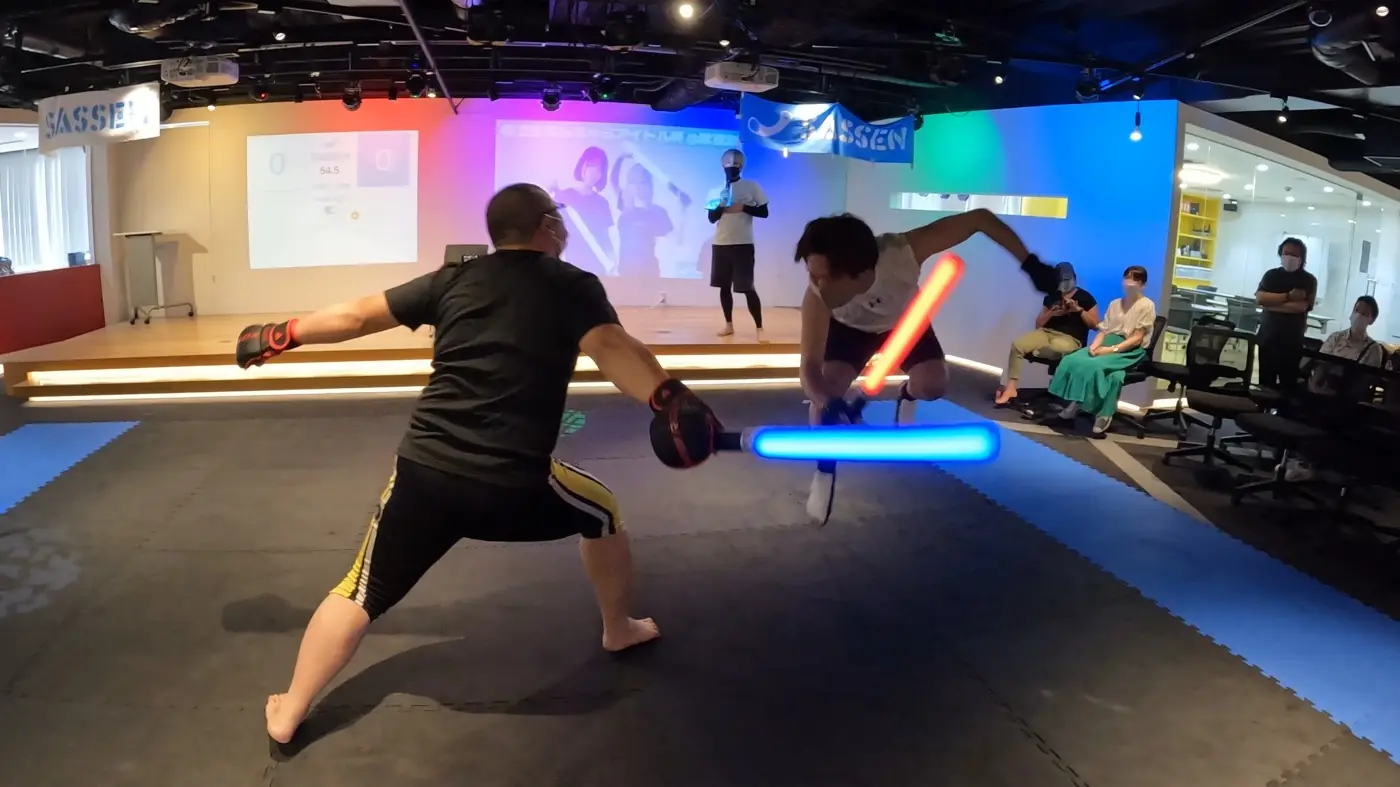
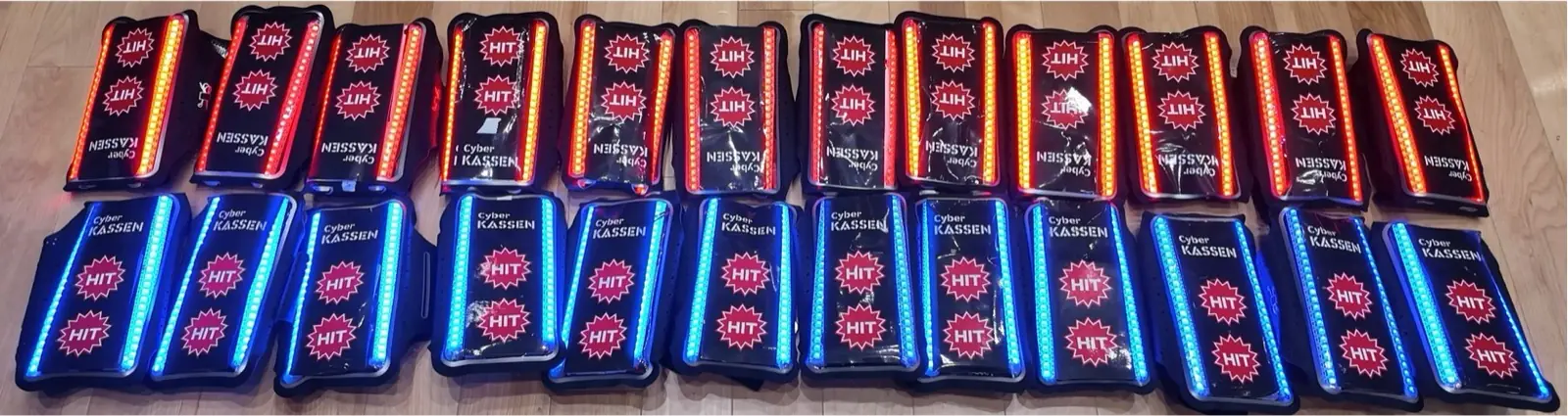
Revot has also taken its own products from prototype to production. The SASSEN sword has pressure and acceleration sensors inside and judges strikes with a precision of 0.025 seconds; about 100 prototypes were built before it was finished. For Cyber KASSEN, Revot manufactured enough wearable devices for several hundred people to wear at once at a live event. These devices are described in more detail on the main English page: Devices and systems Revot has built.
Indicative cost by stage
The amounts are indicative figures in Japanese yen. They exclude consumption tax and move up or down with the requirements. Prototypes can be ordered from one unit, and the work can proceed stage by stage.
| Stage | Indicative cost | Duration |
|---|---|---|
| Proof of principle (it only has to work) | From JPY 500,000 | 3 weeks to 2 months |
| One prototype in usable form | From JPY 1.5 million | 2–5 months |
| Small-lot prototypes | From JPY 3 million | 3–6 months |
| Through design for mass production and 技適 certification | From JPY 5 million | 6–12 months |
The first consultation and the rough estimate are free of charge. Every estimate comes with a breakdown of what each part costs.
What you want to confirm decides what is built
The first thing Revot asks is what you want to confirm, because a different purpose means a different prototype and a different cost.
| What you want to confirm | What is built | Indicative cost |
|---|---|---|
| Is it technically possible? | A device that only confirms the principle. Appearance does not matter. | From JPY 500,000 |
| Will people use it? | The shape and the feel of operation are reproduced. The inside can be simple. | From JPY 980,000 |
| Does it reach the accuracy and performance needed? | Sensors and processing as in the final product. The enclosure is temporary. | From JPY 1.5 million |
| Can it be mass-produced? | Built with the parts, processes and unit cost planned for production. | From JPY 3 million |
| Showing it at a trade show | Appearance and operation come first. Durability is traded off. | From JPY 980,000 (about 2 months from order) |
Trying to meet all of these purposes in one prototype makes both the cost and the time jump, so the first prototype is narrowed down to one question.
How long a prototype takes
A PCB prototype usually goes through 2–3 versions. A plan that expects the first version to be the final one breaks down.
- Version 1: does the circuit work as intended? This is where wiring mistakes, too little margin in the power supply and parts mounted the wrong way round are found.
- Version 2: does it work in the real enclosure and environment? Noise, heat, connector interference and antenna performance show up here.
- Version 3: can it be mass-produced? Component availability, ease of assembly and ease of testing are checked.
Some things only show up in a physical unit; noise and heat in particular cannot be fully predicted by simulation.
Some components take several months to obtain. If they are ordered only after the design is finished, the project waits for them, so lead times are planned for during design.
If there is a fixed date, such as a trade show, Revot asks when you need it, works back from that date and tells you what can be built by then.
How the work proceeds
Revot is based in Tokyo and Ibaraki. Inquiries in English are handled by email, and documents and drawings can be sent as attachments.
Email what you want to build (free of charge)
A specification is not required. What you want to measure, or how the device should behave, is enough to begin. Revot asks about the intended use and the conditions where it will be used.
Non-disclosure agreement, if needed
What you tell Revot is treated as confidential. If needed, a non-disclosure agreement is signed before the consultation.
Rough estimate (free of charge)
Revot tells you which of the ranges above the project is likely to fall into and roughly how long it will take, together with the reasoning.
Requirements and formal estimate
What is to be built is defined in concrete terms, and the estimate is prepared in a form that shows the breakdown of the work.
Feasibility check
Revot first checks whether the sensor can capture the target, whether the battery will last and whether the wireless link will reach.
Prototype
Revot builds a working prototype and tests it in the real operating environment. The design assumes that the specification will change at this stage.
If you continue: small lots and design for mass production
Yield, component supply, the inspection process and unit cost are worked out. For manufacturing itself, Revot works with partner companies.
From the initial inquiry through technical decision-making, projects are handled directly by Seita Sukisaki, the representative director, who holds a master's degree in engineering and an MBA from the University of Tsukuba and is enrolled in its doctoral program.
What to decide before you ask
The more of these points are settled first, the fewer prototype versions are needed. Not everything has to be decided, though: points that are still open can be worked out together.
- What you want to confirm: whether it can be done at all, whether people will use it, whether it reaches the accuracy needed, or whether it can be mass-produced. This decides what is built.
- How many units in the end: whether it is one, 100 or 10,000 changes the choice of components.
- Where it will be used: indoors or outdoors, whether it gets wet, whether it may be dropped, vibration and temperature.
- Power: battery, USB or an external supply, and for a battery, how many hours it should last. Components cannot be chosen until this is decided.
- Size and shape: whether the enclosure it has to fit into is already decided.
- Wireless: if the device uses it, room for the antenna is set aside at the start, because making room later almost always means starting the design again. In Japan, a device with a radio function generally needs 技適 (Japan's certification for radio equipment) before it is sold or used.
- Certification: if the product needs certification, for example as radio equipment or as a medical device, this is checked before design.
- When you need it: for example, the date of a trade show.
- Target unit cost, if you have one: the component configuration is chosen to meet it.
Frequently asked questions
Can I contact Revot in English?
Yes, by email. Revot accepts inquiries in English at contact@revot.jp. The contact form on this site is in Japanese, so please use email if you write in English.
Can I order just one prototype?
Yes. Prototypes can be ordered from one unit. As indicative figures, a proof of principle (it only has to work) is from JPY 500,000 and takes 3 weeks to 2 months, and one prototype in usable form is from JPY 1.5 million and takes 2–5 months, excluding consumption tax.
I only have an idea, with no drawings or specification. Can I still ask?
Yes. Inquiries at the idea stage are welcome. At that stage Revot examines technical feasibility, gives a rough estimate and proposes how to proceed. The first consultation and the rough estimate are free of charge.
Will you sign a non-disclosure agreement before I explain my idea?
Yes, if needed. What you tell Revot is treated as confidential, and a non-disclosure agreement can be signed before the consultation.
How many times does a prototype have to be rebuilt?
It depends on what is being built. Revot's own sports device with built-in sensors went through about 100 prototypes before it was finished. A PCB prototype usually takes 2–3 rounds: checking that the circuit works, checking it in the enclosure and the environment, and changing it into a form that can be mass-produced.
Can you continue to small-lot production after the prototype?
Yes. As indicative figures, small-lot prototypes are from JPY 3 million and take 3–6 months, and work through design for mass production and 技適 certification (Japan's certification for radio equipment) is from JPY 5 million and takes 6–12 months. If mass production is the aim, the prototype is designed from the start with parts and processes that can be used in mass production. For manufacturing itself, Revot works with partner companies.
Can I order only part of the work, such as the enclosure or the PCB?
Yes. At the prototype stage, though, problems tend to appear at the boundaries between circuit, firmware and app, and when these are split between companies, time is lost just finding the cause. Revot handles all of these layers in-house, so that split does not occur.
Can you build a working prototype for a trade show?
Yes. A trade-show prototype gives priority to appearance and operation, and durability is traded off. As an indicative figure it is from JPY 980,000, excluding consumption tax, and takes about 2 months from order. Revot asks when you need it, works back from the date of the show and tells you what can be built by then.
Do the amounts on this page include tax?
No. The amounts are indicative figures in Japanese yen that exclude consumption tax, and they move up or down with the requirements.
Contact Revot
Inquiries in English are accepted by email at contact@revot.jp; the contact form is in Japanese. Seita Sukisaki, the representative director, replies directly within one to two business days. It helps if your first email covers the points under What to decide before you ask; points that are still open are fine.
Revot Co., Ltd. / 3-16 Ichigaya-Tamachi, Shinjuku-ku, Tokyo 162-0843, Japan
Pages in Japanese: Prototyping / PCB design and electronic device development / Integrated development of mechanics, circuits, firmware and apps / Works and case studies / Frequently asked questions / Company profile