

Robot development and IoT development under contract, by one company
Revot Co., Ltd., a University of Tsukuba spin-off in Tokyo, takes on robot development and IoT development as one company, so customers do not need to order each layer from a different company. Robots and IoT devices share the same structure: they sense, judge, and then act or transmit. Revot developed and delivered an autonomous mobile robot using ROS for a major construction consulting firm, and manufactured and operated hundreds of wearable devices worn by up to 100 players at the same time in one match. As a guide, a PoC costs JPY 980,000 and up, IoT device development JPY 3 million and up, and development that includes robots or autonomous mechanisms JPY 5 million and up (excluding consumption tax).
Inquiries in English are accepted by email at contact@revot.jp. The contact form on this site is in Japanese. Revot replies in English or Japanese.
The difference between robots and IoT
The difference is the final action. A robot moves a machine based on its judgment; an IoT device transmits measured data over a network. Robot development means designing and manufacturing machines that recognize their surroundings with sensors, make a judgment and move with motors. IoT development means connecting devices to a network so that measured data can be collected and used. The key design point is the balance between data volume and battery life: sending all data continuously would exhaust both the battery and the connection, so Revot processes data on the device and sends only the information that is needed.
| Step | Robot | IoT device |
|---|---|---|
| Sense | Recognizes the surroundings with sensors | Measures a state with sensors |
| Judge | Determines the state from the measured values | Processes data on the device and selects only the information that is needed |
| Final action | Moves a machine with motors | Connects to a network to collect and use the data |
A robot that is connected to a network and sends measured data while it moves (an IoT robot) combines both.
Sense, judge and act: one company builds every layer
| Layer | What it does | What Revot covers |
|---|---|---|
| Sense | Captures a state with sensors (acceleration, pressure, distance, images and so on) | Sensor selection, circuit design and PCB design |
| Judge | Determines the state from the measured values | Judgment processing on the device, and AI or machine learning when needed |
| Act or transmit | Controls motors, or sends data wirelessly | Control circuits, BLE, Wi-Fi and proprietary wireless |
| View and store | Checks and stores the data in an app or business system | App development and system development in-house |
| Build | Moves from prototype to mass production | Enclosure design, prototyping and design for mass production |
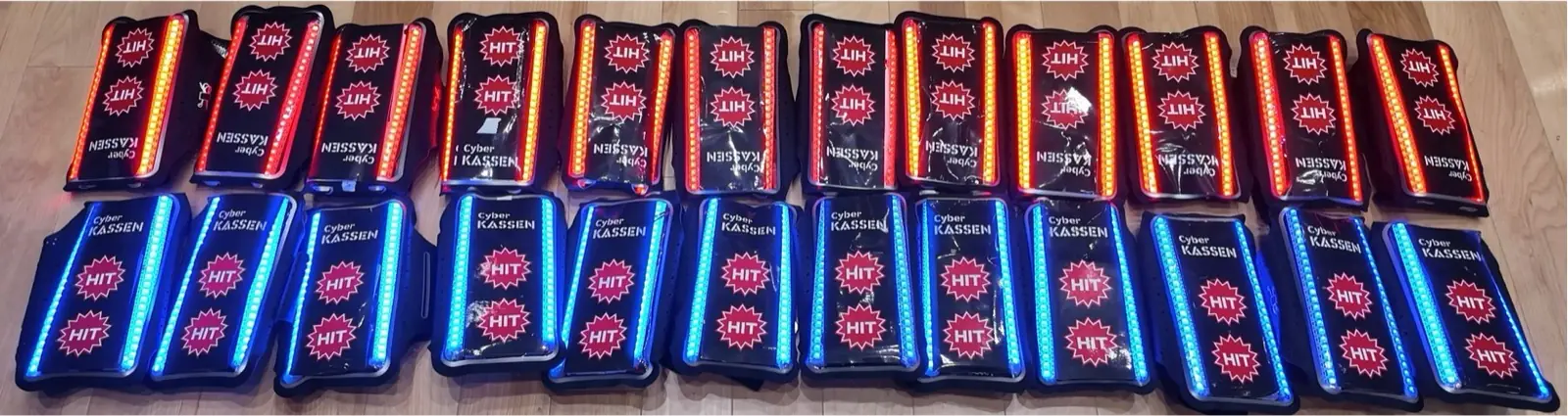
Revot designed these sensor devices in-house and manufactured them in the hundreds. The chain that robot and IoT development needs, from sensor to judgment, wireless and app, is already mass-produced and used in the field.
What Revot develops
Measurement systems (sensing)
Systems that measure physical quantities with sensors, then judge, record and share the results. In SASSEN, Cyber KASSEN and Cyber Molkky, Revot runs systems that detect strikes and contacts at the millisecond level and judge them immediately. This technology can also be used to record work motions in manufacturing and logistics, for safety management and for distributed sensing of equipment.
Control systems
Systems that move equipment based on measured values: motor control, control of LEDs and displays, automatic opening and closing, and autonomous movement. Autonomous flight control of drones is an application of this field. Revot has also flown its own aircraft autonomously in places where GPS does not reach (GNSS-free autonomous flight). Revot also takes ODM work to design and prototype transport and delivery robots under the customer's brand.
Systems that run many devices at the same time
A system that works with one device can fail in communication when there are hundreds. Revot runs Cyber KASSEN, in which up to 100 players compete at the same time in one match, and has design experience in large-scale simultaneous operation. Up to 100 wearable devices are synchronized simultaneously in one match, and 673 people in total have actually used them.
How it helps digital transformation and automation
Digital transformation (DX) means changing business processes themselves with digital technology. Turning paper into PDF files alone is not DX. It becomes effective when data is collected automatically:
- Data is collected without manual input: sensors and IoT devices record it automatically.
- Judgment happens on the spot: the system judges the state from the collected values and reports only anomalies.
- Records connect to the business system: no copying or re-entering.
This requires building both the equipment in the field and the system. Revot can do both as one company.
From prototype to mass production
- PoC (confirming feasibility): Revot builds and tests only the most uncertain part on a small scale. JPY 980,000 and up and 1 to 3 months as a guide.
- Prototype: Revot builds a prototype that can actually be used, tests it in the field and finalizes the requirements.
- Design refinement: Revot finishes the PCB design, enclosure design, firmware and companion app to production quality.
- Certification: a device with a wireless function needs Japan's technical conformity certification for radio equipment (giteki). Revot checks at an early stage whether it applies.
- Design for mass production: Revot redesigns the product so that it can be made in quantity, taking into account parts availability, ease of assembly, inspection methods, yield and cost.
Revot manufactured the Cyber KASSEN wearable devices not as a single prototype but in the quantity worn by hundreds of people at live events. Revot's strength is that a project does not have to stop short of mass production.
Deliverables: hardware, design data (circuit diagrams, PCBs and 3D data), bill of materials, source code, parameter list and test reports. A transfer of rights can be discussed. Business partners that Revot discloses publicly: National Institute of Advanced Industrial Science and Technology (AIST), University of Tsukuba, National Agriculture and Food Research Organization (NARO), Tsukuba City, Nippon Koei, Skymatix, FLIGHTS, Japan SASSEN Association and others. The representative director, Seita Sukisaki (University of Tsukuba: Master of Engineering, MBA, doctoral program), handles everything from the first contact to technical decisions directly, so no gap in responsibility arises from a division of labor.
Cost and duration of robot and IoT development
| Scope | Indicative cost | Duration |
|---|---|---|
| PoC and prototype (verification only) | JPY 980,000 and up | 1 to 3 months |
| IoT device development | JPY 3 million and up | 4 to 10 months |
| Measurement and control systems | JPY 3 million and up | 4 to 10 months |
| Development including robots or autonomous mechanisms | JPY 5 million and up | 6 to 12 months |
| Design for mass production (separate) | On request | 3 to 6 months |
All amounts exclude consumption tax.
What to decide first in IoT: power comes before the communication method
The first question Revot asks about an IoT device is whether there is a power supply at the site. Most of the design depends on it.
| Power | Possible communication | Constraint |
|---|---|---|
| Constant power supply | Wi-Fi, wired or anything | Installation sites are limited, and wiring work adds cost |
| Battery replaced at intervals of a year or more | LPWA, BLE, intermittent operation | Constant communication is impossible; a few transmissions a day are realistic |
| Battery that can be charged often | Wi-Fi and LTE are also possible | Operation must define who charges it |
| Solar and similar sources | Mainly LPWA | Design for the worst case in winter and shade; a design based on sunny days stops |
A request to run on a battery for three years and send data every five minutes cannot be met physically. The first task is to decide which has priority. Many cases can be solved by adjustments such as reducing transmission to once a day.
| Method | Range | Data volume | Suited to |
|---|---|---|---|
| BLE | Tens of meters | Small | Connecting to smartphones; wearables |
| Wi-Fi | Tens of meters indoors | Large | Sites with power; sending images |
| LTE / LTE-M | Anywhere within coverage | Medium to large | Moving devices; standalone installations |
| LPWA (LoRa and others) | Several kilometers | Very small | Numbers only, a few times a day; images cannot be sent |
| Wired (LAN / RS485) | Depends on cabling | Large | Inside factories; uses that must not stop |
When in doubt, Revot decides from the amount of data to send. Numbers such as temperature or open and closed states reach several kilometers with LPWA, and the battery lasts for years. If images or sound must be sent, LPWA is no longer an option.
Failures to plan for in robots and IoT
- Places without radio coverage: coverage calculated on paper differs from the site. Measuring before installation is the only reliable method.
- Not noticing that data has stopped: devices stop silently. Revot builds in a notification when no data arrives for a set time.
- Firmware that cannot be updated: if every fix requires a site visit, operating costs rise sharply. Revot prepares remote updates from the start.
- Clock drift: comparing data from several devices requires a design for time synchronization.
- No recovery after a power failure: whether a device restarts automatically when power returns must be tested.
- Discontinued parts: for operation over several years, Revot designs on the assumption that parts will be replaced.
Revot handles mechanics, circuits, PCBs, firmware, communication, servers and apps as one company. In IoT, problems often cross layers, and days can be lost just in finding out whether the cause is on the device or the server side. Having no split between companies makes a practical difference.
Frequently asked questions
Can I commission robot and IoT development from one company?
Yes. Revot covers sensor selection, circuit and PCB design, on-device judgment, BLE, Wi-Fi and proprietary wireless communication, companion apps, business systems, enclosure design, prototyping and design for mass production. Revot developed and delivered an autonomous mobile robot using ROS for a major construction consulting firm, and manufactured and operated hundreds of wearable devices worn by up to 100 players at the same time in one match.
What is the difference between IoT and robots?
A robot recognizes its surroundings with sensors, makes a judgment and moves with motors. IoT connects devices to a network so that measured data can be collected and used. Both have the same structure up to sensing and judging; a robot then moves a machine, and an IoT device transmits data.
How much does robot and IoT development cost?
As a guide, a PoC or prototype (verification only) costs JPY 980,000 and up and takes 1 to 3 months, IoT device development JPY 3 million and up and 4 to 10 months, measurement and control systems JPY 3 million and up and 4 to 10 months, and development including robots or autonomous mechanisms JPY 5 million and up and 6 to 12 months, all excluding consumption tax. Design for mass production is quoted separately.
Does a device with a wireless function need certification?
Yes. To sell or use a device that emits radio waves in Japan, Japan's technical conformity certification for radio equipment (giteki) is required in principle. At the first consultation, we check whether it applies and then plan the development and the schedule.
Can I contact Revot in English?
Yes. We accept inquiries in English by email at contact@revot.jp. The contact form on our site is in Japanese. We reply in English or Japanese. Tell us what you want to detect and what you want to do, and Revot will work out the sensors, communication and processing needed. If you have documents or drawings, you may send them to the same address.
Contact Revot
Inquiries in English are accepted by email at contact@revot.jp; the contact form is in Japanese. Seita Sukisaki, the representative director, replies directly within one to two business days.
Revot Co., Ltd. / 3-16 Ichigaya-Tamachi, Shinjuku-ku, Tokyo 162-0843, Japan
Pages in Japanese: This page in Japanese / Company profile / Works and case studies