

Sports device development under contract, from planning to mass production
Detect with sensors, decide the result on the spot and let hundreds of people play at the same time. Revot Co., Ltd., a University of Tsukuba spin-off in Tokyo, developed the devices and systems of the digital sports SASSEN, Cyber KASSEN and Cyber Molkky, and has put them into actual operation: they have been reported on TV and used in national tournaments and school classes. Revot offers this technology as contract development, covering planning, circuit design, firmware, companion apps and design for mass production.
Inquiries in English are accepted by email at contact@revot.jp. The contact form on this site is in Japanese. Revot replies in English or Japanese.
What sports device development is
Sports device development means designing and manufacturing hardware and systems that measure and judge players' movements, contacts and scores by combining sensors, wireless communication and judgment algorithms.
In development, sports technology falls into three types that need very different technologies, so the starting point is to decide which one to build:
| Type | What is built | Technologies needed |
|---|---|---|
| Creating a sport | A new competition system that decides results with sensors | Sensors, judgment algorithms, wireless, enclosures |
| Measuring | Devices that measure form, speed, heart rate and so on | Sensors, signal processing, apps |
| Running events | Tournament management, score management and streaming systems | Web systems, databases, real-time communication |
Revot has developed the first type, a complete set that detects with sensors, judges on the spot and displays the result, and has run it in the market.
Four conditions for a new sport to work
To run a digital sport in practice, four technical conditions must be met at the same time. If one is missing, the system cannot be used at events.
- Judgment without wrong calls: when a sensor detects a hit, the system must tell a valid strike from a graze or from devices hitting each other. A threshold alone is not enough; the algorithm must judge from the signal waveform. A sport stops working after a few wrong calls, so this is the hardest part.
- Results on the spot (low latency): detection, communication, judgment and display must happen fast enough to feel immediate to players and spectators.
- Hundreds of users at the same time: in school classes and events, tens to hundreds of devices run in one place. Radio congestion, clock drift and data loss must be solved, or the scoring breaks down.
- Durable devices with enough battery: people swing, hit and sweat. The battery must last a full-day event, and the devices must survive being dropped.
Three digital sports developed by Revot
None of them is a prototype. Between them, they have been in real operation at national tournaments and in school classes, and have been covered on TV.
SASSEN
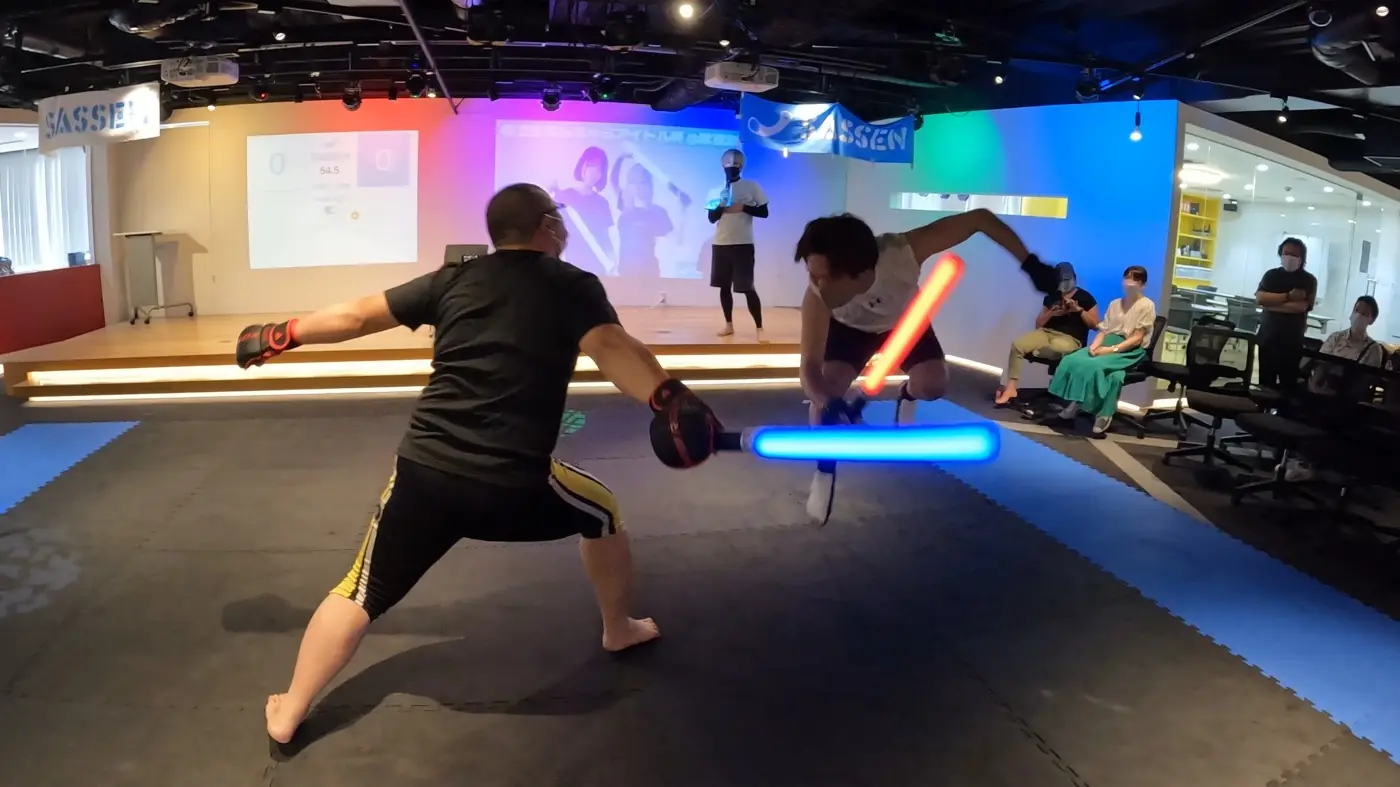
A one-on-one sport in which safe swords with built-in sensors (LED swords) detect strikes and one smartphone judges whether each strike is valid. It has been covered by NHK WORLD-JAPAN, the Fuji TV program Mezamashi TV, the Nippon TV program Guruguru Ninety-Nine and others, and more than 120 participants took part in the 4th national tournament. The Japan SASSEN Association (JSA) runs the competitions.
Cyber KASSEN
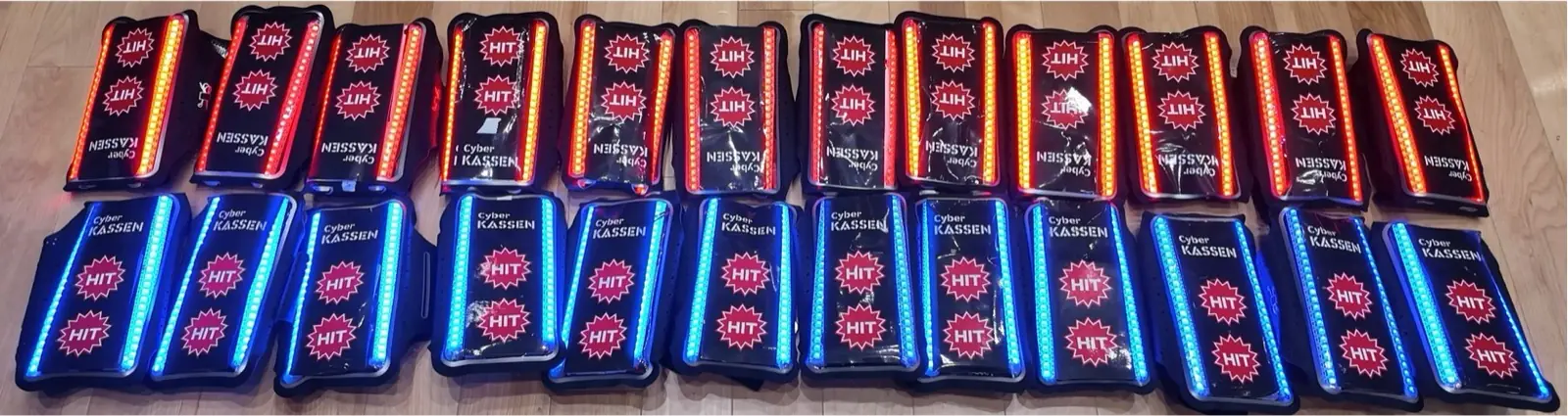
Players wear wearable devices, and real-time synchronization over Revot's own Wi-Fi scores group battles of hundreds of people automatically, with up to 100 players in one match. The design gives every player a role, even when players differ in fitness or experience.
Cyber Molkky
Revot turned Mölkky, a game from the Nordic countries, into a sport with electronic measurement and automated score calculation and records. Revot has filed an international patent application under the Patent Cooperation Treaty (PCT) for related technology.
Track record in numbers
| Where | Scale and content |
|---|---|
| Okinawa Cellular Festival (2 days) | 673 participants in total |
| SusHi Tech Tokyo 2026 | About 500 participants |
| Fukuoka Prefectural Yahata High School interclass sports competition | 280 participants |
| Tachikawa Municipal Fourth Junior High School | Used in physical education classes |
| Kamiyama Marugoto College of Design, Engineering and Entrepreneurship | Used in classes and events |
| SASSEN 4th national tournament | More than 120 participants |
One prototype and hundreds of devices at a live event are different jobs
The most underestimated point in sports device projects is the gap between being able to build a device and handing it to hundreds of people on the day of an event with every unit working. This gap is decided not by technical ability but by whether the design withstands operation. Revot manufactured devices for Cyber KASSEN, worn by up to 100 players at the same time in one match, and used them with 673 participants in total at the Okinawa Cellular Festival, about 500 at SusHi Tech Tokyo 2026 and 280 at a school interclass sports competition.
| Item | Not visible with a prototype | What happens at a live event |
|---|---|---|
| Charging | Plug in one device the night before | 100 devices must be fully charged by the morning: charging stations, a cable for each device and a way to tell which are charged |
| Pairing | Connect each device by hand | 100 devices must be recognized within minutes; setting them one by one delays the start by an hour |
| Radio | It connects on the desk | Hundreds of devices and the spectators' smartphones in a gym congest Wi-Fi and break synchronization |
| Wearing | You put it on correctly yourself | Elementary school children wear it upside down, it shifts, it comes off and flies away |
| Failures | Just repair it | It cannot be repaired during a match; spare devices and a replacement procedure are needed |
| Hygiene | Not a concern | Wiping before handing over to the next group; materials must withstand sweat and disinfectant |
Revot runs many devices at the same time with its own Wi-Fi synchronization method. A design that simply adds more standard BLE (Bluetooth Low Energy) connections stops working at a few dozen devices. The number of devices to run at the same time must be decided before designing the first one.
A sport needs judgments that can be explained
When creating a sport judged by sensors, being able to explain to the losing side why the judgment was made matters more than accuracy itself. If judgments are not accepted, a sport does not last, however correct it is technically. In judgment design, Revot always decides the following:
- Numerical boundaries: define a hit not as "a strong hit" but as "at least X G for Y milliseconds". Vague words lead players to interpret the rules differently.
- Same input, same result: outdoors, sunlight, wind and ground change every time. In Cyber Molkky, returning the same judgment under changing conditions was the hardest point of the design.
- Which way a wrong judgment falls: decide whether to miss a hit or to count too many, in the direction the sport can accept.
- Records: with logs that can be reviewed later, a protest becomes a verification.
Intellectual property and consultations
When creating a new sport, whether imitation can be prevented is a premise of the business. For its own sports, Revot has filed an international patent application under the PCT for Cyber Molkky and has registered the Cyber KASSEN trademark. Protection should cover not only the device itself but also the parts that make the sport work: the judgment method, how points are given and how several devices are synchronized. Protecting only the appearance of a device cannot prevent a sport with the same rules from being built with another implementation. Revot can consider what should be protected at the same time as development; if this starts after development, some parts may already be disclosed and can no longer be filed. Revot takes consultations such as the following.
- Creating a new sport: from the stage of a rule idea, Revot turns it into a form that can be judged.
- Digitizing an existing sport: automating score calculation, records and judgment.
- Running it at events for hundreds of people: from the design of multi-device synchronization to operation.
- Applications beyond sports: motion detection, safety management and event effects.
Revot develops hardware and software in one team, so detection (devices) and judgment (software) are not split. For Cyber Molkky, the digital sport Revot developed, the official website, cyber-molkky.jp (in Japanese), has details by use: what digital sports are, prices and installation costs, rental, and recruitment of agents and partners.
Cost and duration of sports device development
| Scope | Indicative cost | Duration |
|---|---|---|
| Prototype of a competition device | JPY 980,000 and up | 1 to 3 months |
| Complete set including the judgment app | JPY 4 million and up | 4 to 8 months |
| Integration with a tournament management system | JPY 6 million and up | 5 to 10 months |
| Through mass production and event operation | JPY 10 million and up | 8 to 14 months |
All amounts exclude consumption tax. Inquiries in English are accepted by email at contact@revot.jp; the contact form on the site is in Japanese, and Revot replies in English or Japanese. If you have documents or drawings, you may email them to the same address.
Frequently asked questions
Can I commission the development of sports technology devices?
Yes. Revot developed the sensor devices and systems of SASSEN, Cyber KASSEN and Cyber Molkky. We take on sensor detection, judgment algorithms, wireless synchronization of many devices, enclosure design and companion apps, end to end.
Can I consult you about creating a new digital sport?
Yes. From the stage of a rule idea, we help turn it into a technically workable form: what to detect and how, so that a result can be judged. Revot has actually established the new sports SASSEN and Cyber KASSEN.
How many players can play at the same time?
In Cyber KASSEN, up to 100 players compete at the same time in one match. At events, 673 people in total over 2 days took part at the Okinawa Cellular Festival and about 500 at SusHi Tech Tokyo 2026. Tell us the scale you need, and we design from the wireless method.
What is the hardest part of a digital sport?
A judgment algorithm without wrong calls. Even when a sensor reacts, the system must tell a valid strike from a graze or from devices hitting each other. A sport stops working after a few wrong calls, so this work decides success or failure.
Can you judge fouls and show results on a scoreboard that the venue already has?
Yes. We have developed judgment of fouls as well as points, and we also take on connecting the judgment results to a scoreboard that the venue already has.
Can I contact Revot in English?
Yes. We accept inquiries in English by email at contact@revot.jp. The contact form on our site is in Japanese. We reply in English or Japanese.
Contact Revot
Inquiries in English are accepted by email at contact@revot.jp; the contact form is in Japanese. Seita Sukisaki, the representative director, replies directly within one to two business days.
Revot Co., Ltd. / 3-16 Ichigaya-Tamachi, Shinjuku-ku, Tokyo 162-0843, Japan
Pages in Japanese: This page in Japanese / Company profile / Works and case studies